

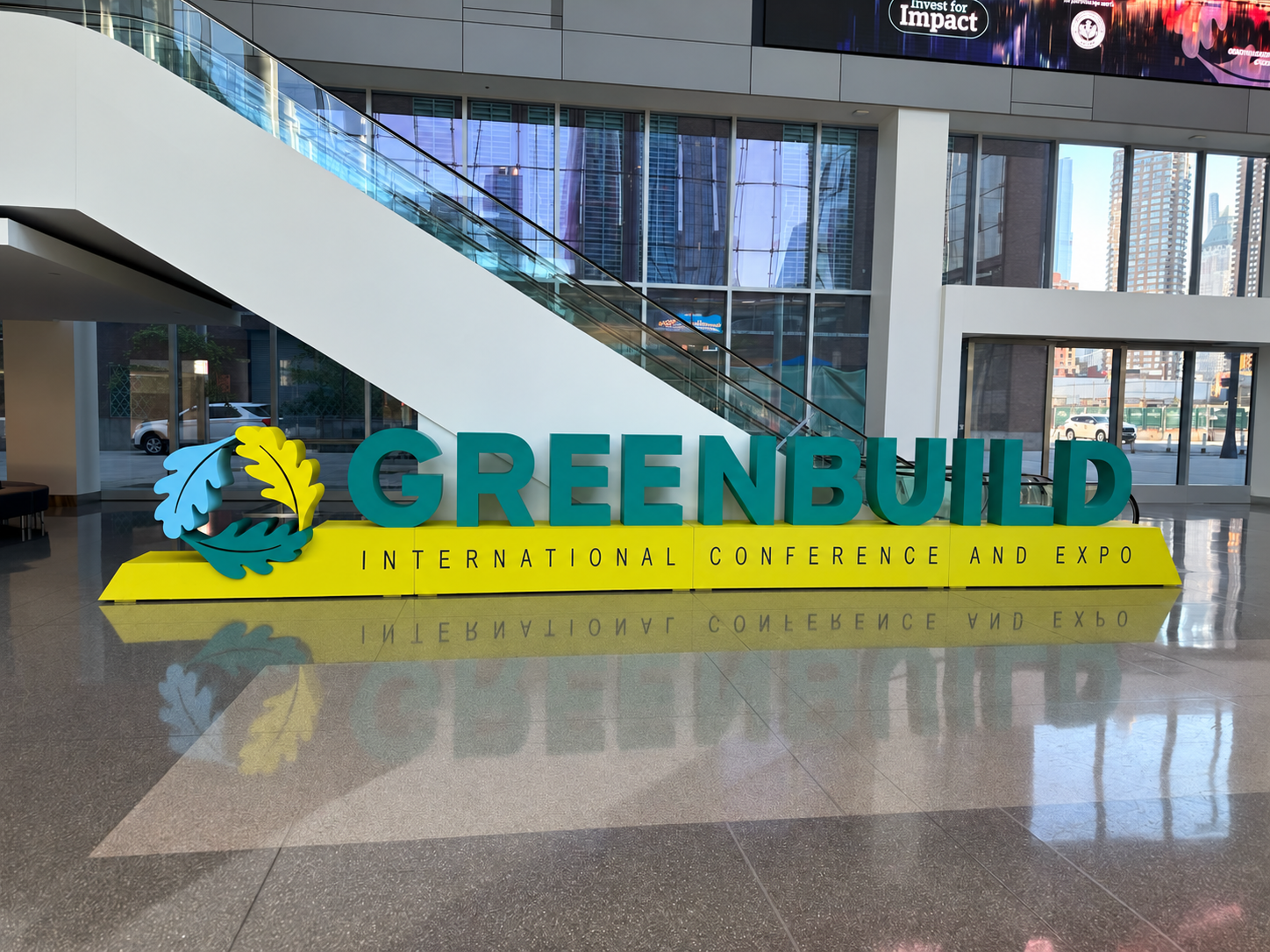
Greenbuild 2026 at the Javits Center in NYC
The Bold Branch Collective team is back from New York and we’ve been thinking about how the green building industry is changing and how companies need to communicate that change.
One thing that was very prevalent at this year’s Greenbuild conference was AI everywhere, and not always in a good way. Risk and resilience also featured prominently in conversations about buildings and investment, and among the people we connected with, relatively few worked in marketing and communications.
For Bold Branch Collective, those observations point to an opportunity: help the industry communicate its value as clearly as it explains its technical solutions. Here are five takeaways we’re bringing home.
The business case needs to lead
One of the strongest themes we noticed last week was the emphasis on risk, resilience, and protecting long-term value. Now, that could be because the Greenbuild 2026 theme was Invest for Impact as these ideas were also featured in Greenbuild’s programming. There were several sessions connecting building performance with asset protection and business continuity. We do think this framing gives companies a useful starting point for their messaging. Companies can talk about how their solution helps a customer manage exposure, control costs, protect an investment, or keep a building operating - and what information supports that claim.
Of course, environmental benefits are still central to the green building movement and connecting those benefits to a customer’s responsibilities makes the value easier to understand and act on.
2. AI is becoming common…but it’s not all clear.
AI appeared across the conference in every form, from technology demonstrations and booth designs, to messaging and AI tool developments.
Some of the booth graphics and content felt increasingly alike and while we have no idea how all of the assets are being produced, the sameness did raise a question: when everyone has access to similar tools, what makes a company recognizable?
At Bold Branch Collective we like to use AI to help organize ideas and themes but decisions about audience, message, design, and accuracy still need someone who understands the business.
3.Marketing and communications belong closer to the technical conversation
Among the people we met, marketing and communications professionals seemed relatively scarce and so many attendees told us they’d never heard of a marketing and communications firm that specializes in green building. Considering that’s exactly why we created Bold Branch, we were pretty excited to hear that. For us, Greenbuild offers much more than opportunities to promote our company. It gives us a chance to hear how customers describe their problems, which questions come up repeatedly, and where an explanation loses someone.
Technical experts bring depth. Marketing and communications teams help connect that expertise to the people who need to understand it, approve it, specify it, or buy it.
4.Technical credibility needs a clear customer connection
Greenbuild brings together people with deep knowledge of materials, building performance, certification, and technology. Communicating this information is a lot harder than it looks! A list of capabilities may explain what a company offers while leaving the buyer to figure out why it matters. A stronger explanation connects the capability to a recognizable situation: a difficult product comparison, missing documentation, a reporting deadline, or a decision about where to invest.
5.Proof needs to be part of the story
Greenbuild’s focus on investment and performance reinforced a communications lesson for us: broad promises need concrete support. The conference’s AI programming, for example, explicitly addressed verifying outputs against actual project conditions.
That same discipline strengthens marketing.
If your solution saves time, show which task becomes easier. If it supports better decisions, explain what information the customer gains. If it helps reduce risk, identify the risk and how the solution addresses it. A useful demonstration or a specific customer example gives a buyer something they can evaluate and share with colleagues.
What we’re taking forward
The green building industry has valuable expertise and a compelling mission - one that we’ve dedicated decades of our lives to. Communicating that value requires the same care companies put into developing their solutions. For us, that means helping organizations explain their business value, support their claims, and give customers a clear reason to take the next step.
We’re excited for the ideas we’ve brought home that will shape our work long after the booths come down!
